How a page of the paper became words you can read
One wedding greeting from the Pruzhaner Shtime, followed from its picture to its English. Each part is labelled just as it is on every piece.
On this page: The picture of the page
The picture of the page
Every issue here starts as a photograph of the printed page, taken by the library that keeps the paper. The picture is the paper itself; everything else here is made from it. Its credit stands under it, as it does under this greeting.
The Yiddish letters, typed out
A computer looked at the picture and typed out the letters it found. That typed copy, the transcription, is what lets the site search the paper and set English beside it. A computer can mistake a letter, a name or a number even where the result looks right, so a line beginning “Text” says who made it:
- Machine transcription
- Typed out by a computer, with no check recorded.
- Machine transcription; parts checked by an AI assistant
- A second computer program compared parts of it with the picture.
- Corrected by a person
- Someone compared it with the picture and put it right.
- Transcriber not recorded
- The record does not say who made it.
Where a word matters, the picture is the one to trust.
Headlines and titles
A headline the paper printed is labelled Printed headline and set in the paper’s own letters. Many short pieces had none, so the site gives every piece a title of its own, in English, in plain bold type just above the English. That title was never in the paper, and most were written by a computer.
The English
The paper was in Yiddish. Each English text says who made it:
- Machine translation
- A computer’s English, with no check recorded.
- Machine translation, parts checked by an AI assistant
- A second program compared parts of it with the Yiddish. That is still not a person’s check.
- Translation corrected by a person
- A person went over the English and corrected it.
- Translated by a person
- A person made the English.
- Who translated this is not recorded
- The record does not say who made the English.
The small raised, underlined “a” beside every translation’s label opens a note on what that label means there. Even English a person has checked can hold a mistake, which is why the Yiddish and the picture stay beside it.
When a transcription changes
Transcriptions get corrected. When one changes, English made from the old letters may no longer fit them. That English is then held back, and “No English yet” stands in its place rather than words that no longer match; a title made from the old letters carries a note saying so. “No English yet” never means the piece was empty.
The people named
A person’s page gathers the pieces that name them. A computer matched the names across the issues, and the line under the person’s name says how many pieces and issues that rests on, and whether a person has checked the matching. Two people with one name can be joined by mistake, and one person spelled two ways can be split, so the links to the pieces themselves are always there to follow.
Records from outside the paper
Some pages also show what an archive or a family holds: a record from Yad Vashem or the Arolsen Archives, a memorial book, a family’s account. These stand apart from the paper, each labelled with where it comes from. Where the site has them, you see the record’s own words, its number, the day it was consulted and a link to where it was found. Where a record may be about someone else of the same name, it says so first.
How German officials’ names were checked
The German officials named in the Bielefeld trial’s judgment were looked up in the Nazi Party’s membership card index, through DER SPIEGEL’s searchable copy of it. Its makers warn that the cards and the computer reading of them can be incomplete or wrong, and that a card found there is a lead, not proof of what anyone believed or did. It is used here only to check a name and a birthday.
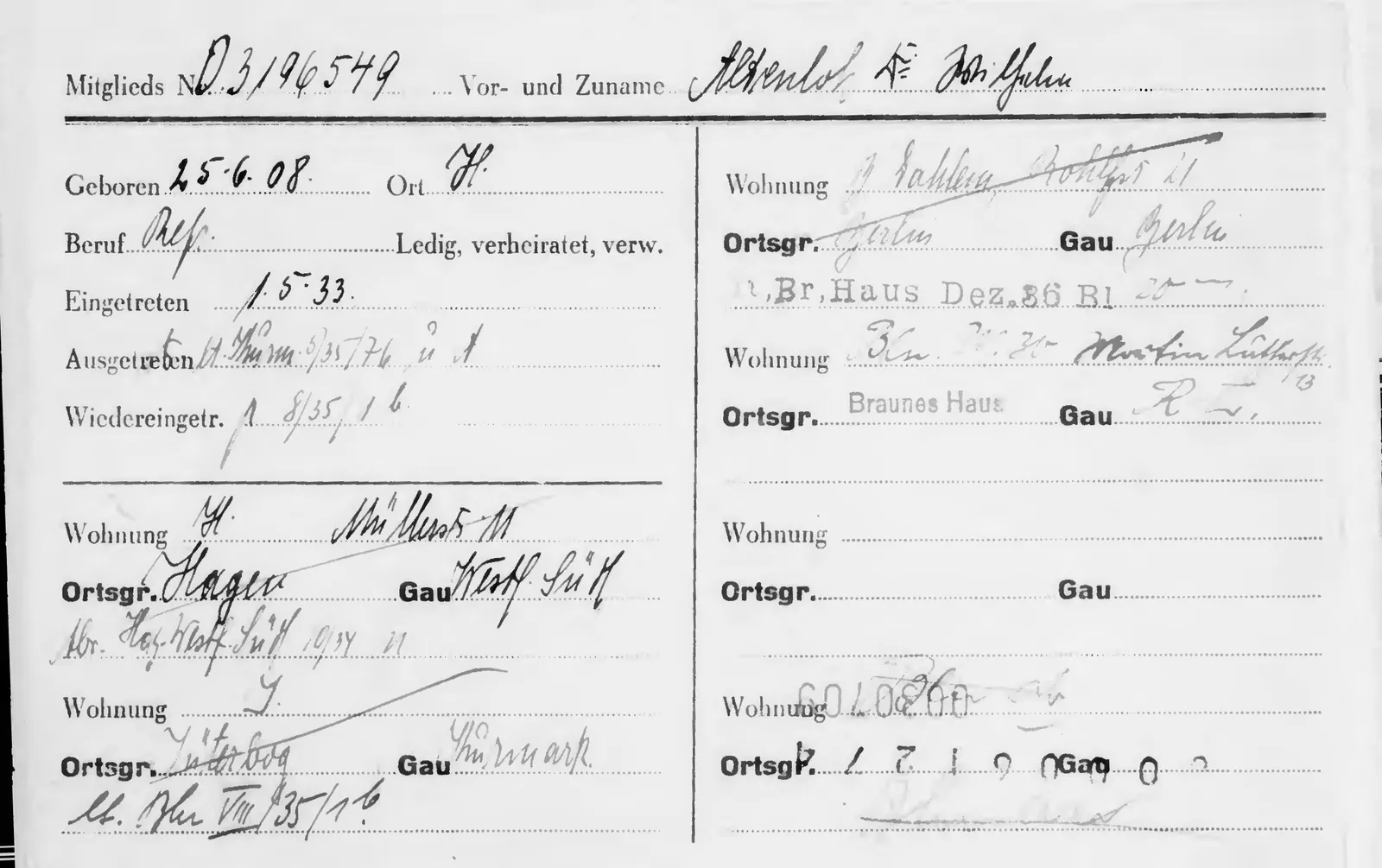
- Wilhelm Altenloh: one card, whose name, birthday and birthplace match the Bielefeld judgment.
- Wilhelm, the security police officer in Pruzhany, and Muth, his subordinate: the sources give neither man a first name or a birthday, so no card can be told to be theirs.
- Heinrich Müller, the head of the Gestapo: no card was found under his birthday. That does not mean there is none; a part of the index was lost at the war’s end.
- The two railway officials: not searched, because the judgment gives only the first letters of their names.
Source: the Nazi Party’s central membership card index (NSDAP-Zentralkartei), originals in the Bundesarchiv, R 9361-VIII KARTEI; scanned in the United States National Archives’ microfilm publication A3340, linked here, not copied; searched through DER SPIEGEL’s “Nazi-Kartei” on 6 November 2026. Altenloh’s card reads “Altenloh Dr. Wilhelm”, “Geboren 25.6.08”, “Ort H.” (the index reads H. as Hagen). How DER SPIEGEL made the index, and its limits (Susmita Arp and others, 7 May 2026, in German).
How sure any of it is
The site counts what it holds: issues, pieces, names. Those counts say how much of the paper is here, not how often the typing, the English or the matching of names is right. No overall accuracy figure is given yet. An honest one needs a sample that people have checked against the pictures, task by task. Until then, each text’s label is the best guide to how far to trust it.